

All research projects are expected to stand up to scrutiny on reliability and usefulness. But when research professionals are presenting to VP-level and C-suite executives—the CFO, CMO, CEO, and other senior leaders—the scrutiny is often more intense.
The stakes are higher because the risks are higher. Executive expectations may be tougher, attention can shift quickly, and a finding that lands badly can damage research credibility. Knowing those risks in advance gives research teams a chance to plan ahead and move through the project with more confidence.
This article draws on Research Rockstar’s “Delivering Research Projects to C-Level Leaders” Live Event, held on September 8, featuring customer insights experts Karen Harvie and Mark Andrews, and Research Rockstar lead instructor Kathryn Korostoff. Their examples show what helps research gain traction with senior executives—and where even strong research can lose momentum.
Why Research Delivery to the C-Suite Is Hard
The risks show up in several ways. Timelines are often compressed, and expectations for speed may not align with the realities of rigorous market research. Executives may also bring strong assumptions shaped by experience or earlier research, which can make unexpected findings harder to accept.
Longer projects create another challenge. A study that feels urgent at kickoff can lose visibility while qualitative research, quantitative research, or other fieldwork is underway. By the time results are ready, executives may have moved on mentally from the original objectives or simply lost track of how the work is progressing.
Coordination can complicate matters further. Internal research teams and external agencies may both have roles in the project, while business stakeholders may have their own expectations for the final presentation. If those roles are unclear, the delivery can become fragmented just when executives need a coherent point of view.
These challenges are easier to manage when they are anticipated early rather than discovered in the final meeting.
Before: Design Market Research for Credibility
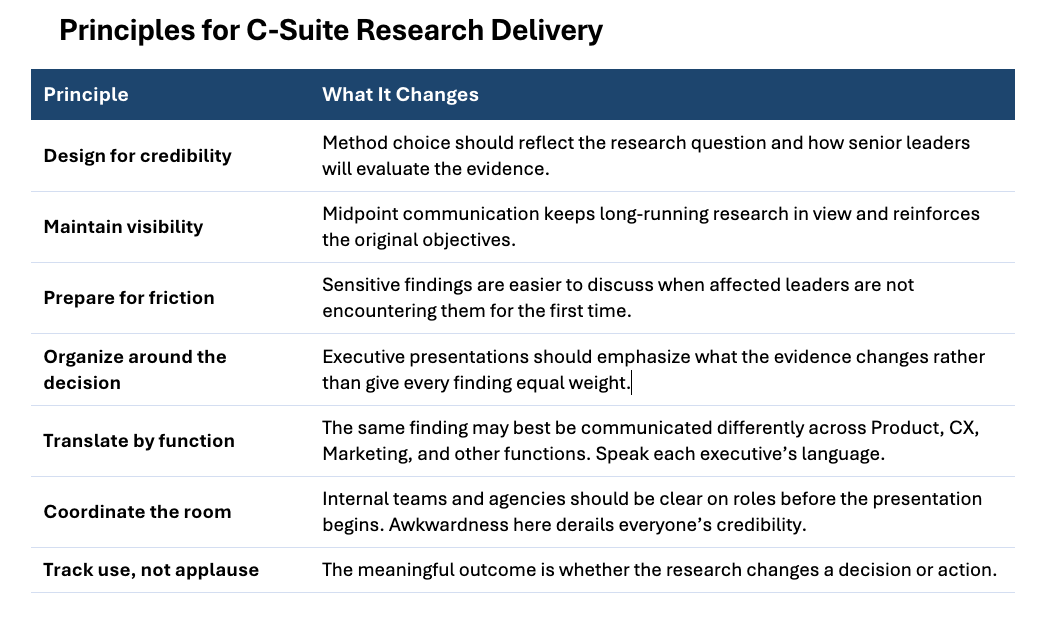
Researchers usually begin with a methodological question: What do we need to learn, and which approach will answer the question reliably? For research intended for senior leaders, another question deserves equal attention:
What evidence will these decision-makers consider credible?
This is about anticipating how the evidence will be evaluated without allowing executive preferences to override research standards.
A leadership team accustomed to large-scale quantitative research, for example, may need more context when recommendations rely heavily on qualitative research. The issue is whether the audience understands why that method is appropriate for the decision at hand.
Individual experience matters as well. An executive who spends significant time with customers may place considerable weight on firsthand anecdotes and question findings that run counter to them. Knowing that in advance can shape how the research is designed and how supporting evidence is assembled.
Build Customer Insights Readiness
Executive requests do not always arrive on a conventional research schedule. Leaders may need an answer quickly and still expect enough rigor to support a meaningful decision.
Research teams are better positioned when they already have credible options available. Existing studies or a customer community may sometimes answer an urgent question without requiring a new primary study from scratch. Field teams or competitive information may also provide useful evidence, depending on the question.
Karen Harvie shared an example of how her customer insights team built a custom research community composed of relevant customer segments. The community could support surveys, discussion boards, interviews, concept tests, naming studies, and other research.
That investment paid off when leadership needed rapid customer input on AI agents being developed for sensitive customer calls. The team adapted a previously programmed monadic concept test and added quantitative and open-ended questions for the appropriate customer segment. AI was used to accelerate analysis of the open-ended responses.
The full process, from team alignment through presentation, was completed in under two weeks. The broader point is that market research and customer insights teams gain flexibility when reusable methods and evidence sources are in place before an urgent request arrives.
During: Execute Research & Maintain Visibility
Long strategic studies can easily fall out of executive view. While researchers are fielding and analyzing the work, senior leaders are dealing with other priorities.
A study that was highly important at kickoff can therefore become less visible over time. Executives may forget the original objectives or lose track of the research plan. In some cases, they may simply stop thinking about the project until the final presentation appears on their calendars.
Midpoint updates help maintain visibility while the research is underway. Brief status updates or selective previews can remind executives what the study was designed to answer and why it matters. The intent is to keep the project present in their minds while the research team continues executing the agreed plan.
Kathryn Korostoff shared a global segmentation example that shows why this matters. The project included qualitative and quantitative research across five countries and was considered strategically important, but data collection alone lasted more than four weeks.
By the time the findings were delivered, the client team had become misaligned on how the segmentation would be used. Everyone’s intent was good, but memories fade over weeks, and with a research scope as precise as developing a market segmentation model, things agreed upon at the start can become points of conflict at the end. In this case, there was clear, documented agreement about how the resulting model would be used, yet by the time of delivery, there was a conflict. Some executives thought the model would be used to tag customers in an existing database, something that had never been discussed or documented. This is the kind of detail that has a real impact on research design and is nearly impossible to retrofit after data collection.
Kathryn’s takeaway was that if the research agency and internal research team had held more midpoint check-ins with the executives, where the documented research objectives could be revisited, the conflict could have been avoided or caught early enough to make a course correction. Those check-ins could also have created opportunities for some needed segmentation education before the final presentation.
A midpoint meeting does not need to become a preliminary results presentation. For long or high-profile projects, the goal is simply to keep the research engine warm.
After: Communicate Research for Influence
Research teams often spend most of their presentation preparation on the deck itself. Yet the conversations that happen before the meeting can have just as much effect on how the research is received.
Mark Andrews shared an example involving a new product concept. The research was overwhelmingly positive: customers were interested, and the product addressed a genuine need. The study also surfaced two issues that would need to be solved before product development progressed.
During the executive presentation, those issues drew the attention of the VPs responsible for the affected areas. The discussion moved away from the broader research story, becoming an important tangent but still a distraction to the broader group, and it took time to return to the central decision.
The research team had not fully anticipated how those findings would land with the leaders most directly affected. A few pre-meetings might have changed the dynamics of the discussion so that the momentum didn’t get diluted.
Researchers can use those conversations to brief key stakeholders and clarify what the evidence shows. They also give affected leaders time to think through likely questions before the executive meeting. That preparation can make the final discussion more productive without diluting the research.
Coordination between internal teams and external agencies matters here as well. Before a final presentation, everyone should know who is presenting and who is best positioned to answer methodological or business questions. Clear roles reduce the risk of mixed signals in front of senior leaders.
Connect Market Research to Decisions
One of the easiest ways to weaken an executive research presentation is to give every finding equal weight. That may be faithful to the project, but it is rarely useful to the audience.
Senior leaders typically do not need a full tour of the study. They need to understand what the evidence changes.
Karen Harvie shared advertising-research examples that make the point. Ad tracking showed that campaigns containing too many messages created consumer confusion. Simplifying the advertising led to clearer storylines and stronger lifts in brand consideration.
Another study found weak brand linkage when a prominent partner logo appeared in the advertising. The partner brand was attracting attention away from the primary brand. After the partnership was discontinued, brand linkage scores and customer-response measures improved.
In both cases, the market research mattered because it supported a business action. Were there lots of data points that could have been presented? Yes. But by focusing on those that precisely pointed to optimizations for what the organization did next, the power of the results was optimized.
Translate Customer Insights by Function
The same finding can mean something different to each executive in the room. A product leader may think about product roadmap or feature priorities. A CX leader may focus on friction in the customer journey. A marketing leader may care most about messaging or brand performance implications. Overall storytelling is key, of course, but we can also tailor parts of that story for the executives we are supporting.
The evidence does not change, but the implications may need to be made explicit for each function. This is especially important in C-suite settings, where several leaders may be evaluating the same research through very different business lenses.
A strong presentation helps each executive see why the finding matters to decisions within their area. That makes customer insights easier to use without oversimplifying the research.
Build Market Research Credibility Over Time
Executive trust in research is rarely built in a single presentation. It develops through repeated exposure to work that is relevant and connected to the business.
Even outside the context of a single project, brief interactions between formal presentations help. In ad hoc executive interactions, the researcher might mention an interesting finding or flag a piece of work underway. These conversations can also connect past or planned research to current hot topics.
The goal is to keep market research and customer insights visible as ongoing business resources rather than functions that appear only when a major study is complete. That credibility can become especially valuable when research later challenges an established assumption or points to a conclusion that senior leaders were not expecting.
Market Research Skills That Support Research Use
Market research and customer insights can inform a wide range of strategic decisions, from brand building and product roadmaps to innovation and advertising. But for senior executives to use research with confidence, they need to understand and trust the data—and the findings derived from it.
That places an important responsibility on the research professionals leading the work. Strong methodology and analysis are essential, but so is good judgment about how the research is designed, communicated, and delivered to maximize the chance that senior leaders will use it.
That judgment is part of the broader set of market research skills developed by experienced practitioners and reinforced through strong market research training. Knowing how to make credible evidence useful to senior decision-makers gives good research a better chance of shaping what the organization does next.
Don’t miss our next Live Events. See topics and dates here.