
B2B research often involves small, hard-to-reach populations, with recruitment constraints that affect both feasibility and the evidence a study can produce. Challenging initial assumptions about recruitment and data collection can open up approaches that better serve the research objectives.
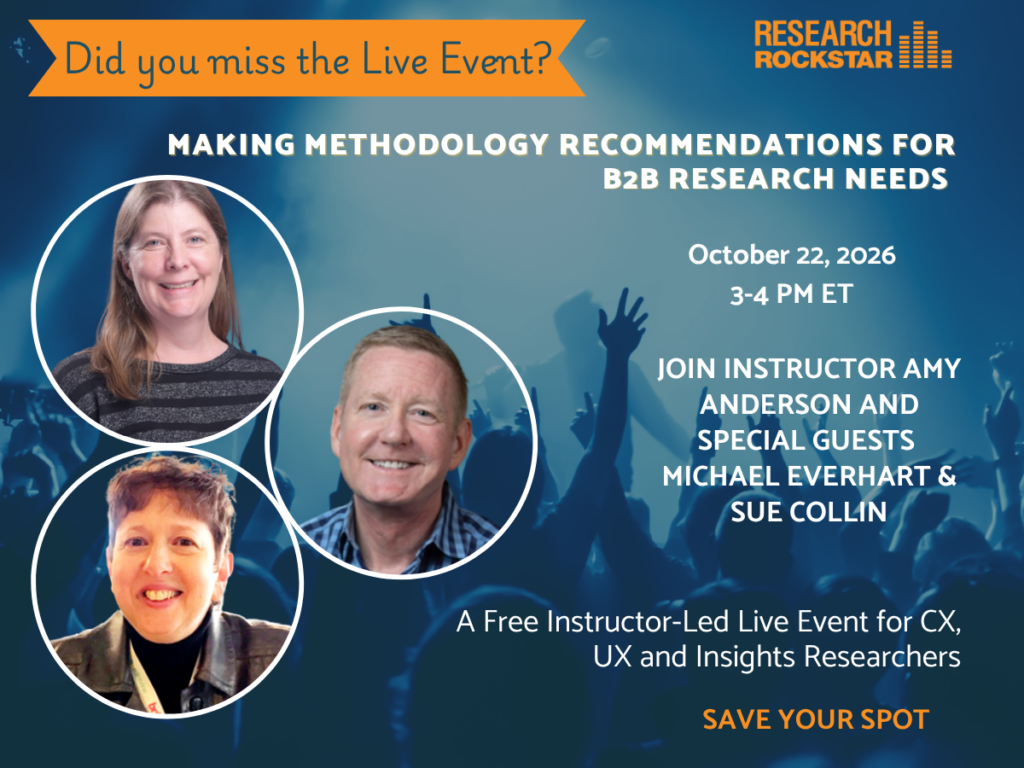
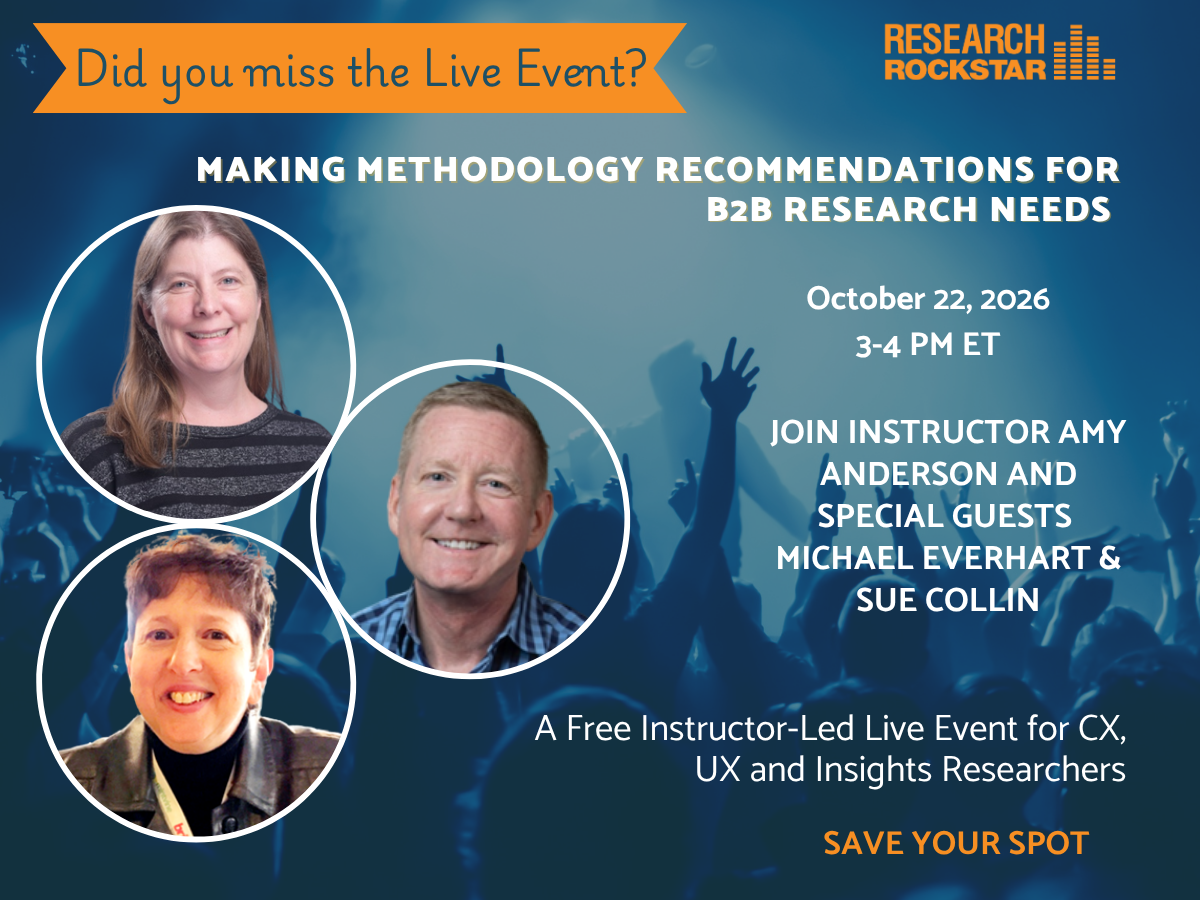
In Research Rockstar’s October 22nd Live Event, Amy Anderson of Solutions Through Research, Sue Collin of RTi Research, and Michael Everhart of Schmidt Market Research examined these decisions through practical examples. Their discussion connected recruitment feasibility with respondent qualification, coverage of relevant roles, and data collection choices.
Establishing Who Qualifies—and Who Can Be Reached
Amy framed the discussion around familiar B2B challenges: limited eligible populations, higher recruitment costs, and difficulty identifying the appropriate people within organizations. Her vignettes emphasized screening for actual responsibilities and relevant experience rather than relying on job titles.
The distinction matters for data quality. A title may suggest eligibility without establishing the person’s involvement in the activity or decision being studied. Amy’s discussion connected precise screening with realistic expectations about recruitment, including when the proposed approach needs to be reconsidered.
Challenging the Specialist-Only Audience Definition
Sue’s medical device case began with a request for interviews with difficult-to-reach specialists. Her team reframed the audience to include both specialists and other care team members whose experiences were relevant to the device’s use.
The rationale extended beyond recruitment convenience. Including additional roles provided perspectives on the care process that a specialist-only design would not capture. Fieldwork subsequently identified medical assistants as another relevant role, prompting further consideration of the people involved in the device ecosystem.
Sue’s team also chose individual in-depth interviews rather than focus groups to accommodate participants’ demanding schedules. The case illustrated two distinct adjustments: reconsidering whose knowledge was relevant and selecting a format those participants could accommodate. Sue also emphasized the value of vetted recruiting partnerships and maintaining current industry contacts.
Using Discovery to Define the Population of Interest
Michael’s financial services case focused on corporate trust and agency services ahead of a potential brand refresh. The relevant audiences included end users, such as large corporations and government agencies, and influential intermediaries, including law firms and private equity firms.
Through iterative discovery conversations with the corporate researcher and executive sponsor, his team clarified the business context and audience requirements. Those discussions established the need to capture perspectives from groups with different relationships to the services and the brand.
For this study, audience definition required understanding both use and influence. That distinction informed which respondents the research needed to reach before the team settled on its recruitment approach.
Challenging Assumptions About Data Collection
Michael’s team determined that online panels would not effectively reach the required senior decision-makers. They implemented a phone-to-web approach that generated nearly 300 survey responses.
The case illustrated how reconsidering the combination of recruitment and survey administration could make data collection feasible for a difficult audience. The achieved sample size documented the approach’s yield; it did not, by itself, establish representativeness or data quality.
Across the two cases, the changes addressed different problems. Sue’s team broadened the audience to include additional relevant roles and used IDIs to accommodate schedules. Michael’s team clarified the audiences through discovery and adopted a phone-to-web approach to reach them.
3 Great Research Experts
Amy, Sue, and Michael generously shared the reasoning behind their methodology choices. And for the attendees, their B2B examples provided a concrete basis for discussing how to optimize a methodology plan, and when to revise an existing one.