
Customer-centric, data-driven decision making has moved well beyond any single source of customer data. Primary research methods such as surveys, focus groups, and in-depth interviews remain vital, but they are now part of a much larger ecosystem of customer-related data sources.
That ecosystem can include CRM data, ecommerce data, loyalty program data, social sentiment data, and many others. For insights professionals, the challenge is not to become experts in every source. The challenge is to build enough fluency to help clients and stakeholders choose which sources can best answer specific business questions—and when multiple sources should be combined.
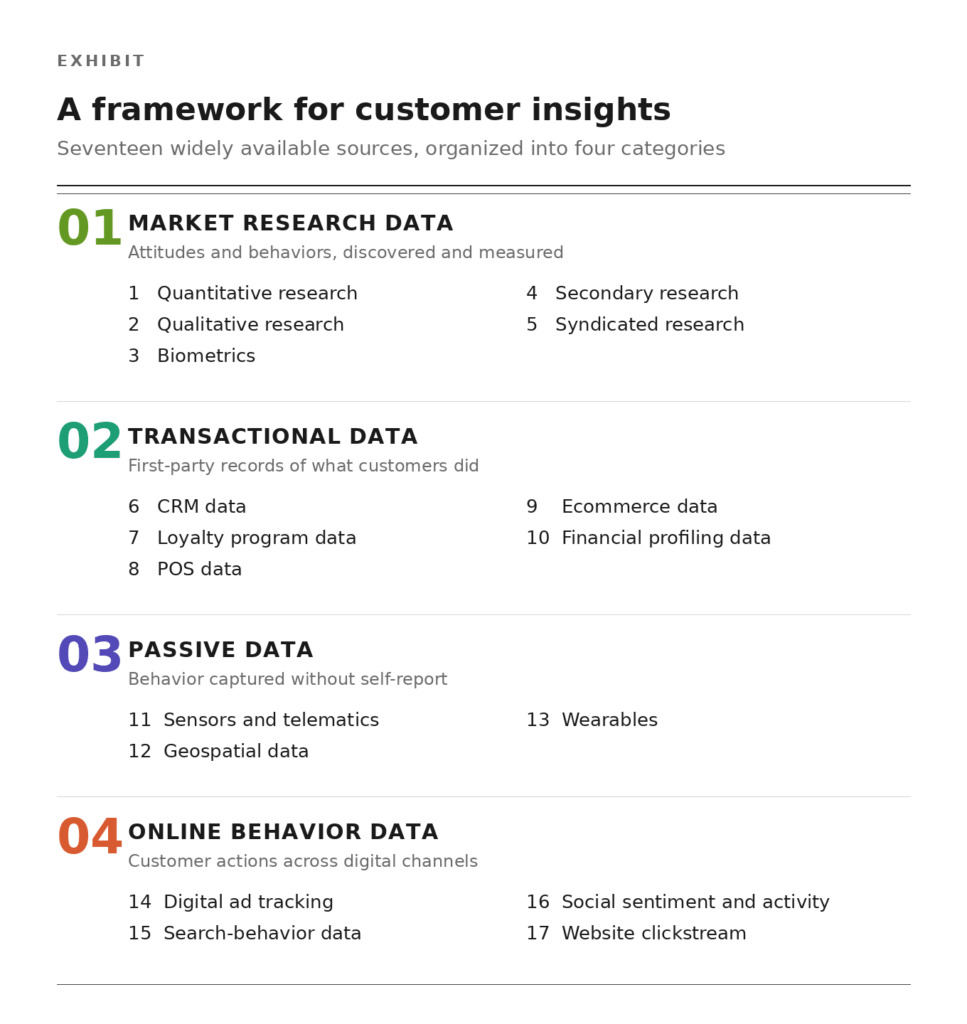
The first step is awareness. To make the landscape easier to navigate, we identified 17 widely available customer data sources and organized them into four broad categories:
- Market research data
- Transactional data
- Passive data
- Online behavior data
Category 1: Market Research Data
Market research data helps us discover and measure customer attitudes and behaviors. Attitudes may include needs, preferences, pain points, values, perceptions, satisfaction, and decision drivers. Behaviors may include purchase activity, product usage, shopping patterns, information-seeking, and brand interactions.
This category typically includes custom primary research, but it can also include secondary and syndicated sources. Examples include:
1. Quantitative research, often including surveys, and also usability testing data, simulated shopping exercises, A/B tests and other experimental methods.
2. Qualitative methods, such as focus groups, in-depth interviews, dyads, and online qualitative research
3. Biometrics
4. Secondary research
5. Syndicated research
Quantitative research measures attitudes and behaviors across a defined population of interest (which may be narrow or broad). Survey research is common, but quantitative market research also includes usability testing metrics, simulated shopping exercises, A/B tests and other experimental methods.
Qualitative methods help us discover and explore attitudes and behaviors in depth. Focus groups, in-depth interviews, dyads/triads, and online qualitative methods allow us to ask questions, probe, and clarify, to learn how people describe a category, product, service, or experience.
Biometrics can measure attention, emotion, or physiological response, such as eye tracking, facial coding, or heart rate response. These methods are most often used in advertising, packaging, product, and digital experience research when we need to understand responses people may have difficulty self-reporting.
Secondary research uses existing information from sources such as government agencies (including Census, SEC, and BLS data), industry associations, academic publications, trade publications, analyst reports, and research firms that specialize in published market and category reports (such as Mintel and Euromonitor). Typically sold as reports or subscriptions, it can help us understand market sizing, category trends, competitive context, and broader environmental factors before deciding whether new primary research is needed.
Syndicated research is data collected and sold by research firms, media measurement companies, or industry-specializing data providers, such as Nielsen, Kantar Media (now Fifty5Blue), MRI-Simmons, and vertical industry specialists. Syndicated research services typically provide data about consumer behavior, brand performance, category trends, competitive benchmarks, and media consumption across channels such as television, streaming, audio, digital, and cross-platform audiences.
Category 2: Transactional Data
Transactional data typically comes from customer interactions with a business (a type of first-party data). It is often generated through operational systems and reflects what customers actually did (in contrast relying on self-reporting).
Examples include:
6. CRM data
7. Loyalty program data
8. POS data
9. Ecommerce data
10. Financial profiling data
CRM data can reveal account history, customer status, touchpoints, sales activity, and service interactions. For B2B and B2C organizations alike, CRM data can help identify customer segments, lifecycle stages, and relationship patterns.
Loyalty program data is collected by companies that have customer loyalty programs, and it typically includes member-level information such as purchase history, purchase frequency, reward activity, retention, and customer value. It can be used to identify loyal customers, occasional customers, dormant customers, and high-value segments.
POS data captures actual purchase activity at the point of sale. It can help answer questions about product movement, basket composition, purchase timing, price sensitivity, and promotion response.
Ecommerce data captures digital shopping behavior, including purchases, abandoned carts, product views, repeat orders, and conversion patterns. It can help teams understand how customers shop online, where they drop off, and which products or experiences are associated with conversion.
Financial profiling data includes customer-level or household-level financial attributes, such as income proxies (inferred data), risk indicators, or estimated customer value. While not always generated by transactions with the business, financial profiling data is commonly appended to customer records for segmentation and targeting. For example, Experian Marketing Services sells access to thousands of attributes that can be used for segmentation and targeting. As with any customer-level data, it requires careful attention to privacy, regulation, and appropriate use.
Category 3: Passive Data
Passive data has a clear appeal for researchers: it can capture actual behaviors, habits, and product usage without relying on human recall. Of course, it applies only to certain topics and contexts—but when it fits, it can be powerful.
Examples include:
11. Sensors/telematics
12. Geospatial data
13. Wearables
Sensors and telematics capture data from connected devices, equipment, or vehicles. Sensor data captures usage activity, environmental conditions, movement, or system performance. Telematics is a related form of sensor-based data used in vehicles and fleets; it may include location, speed, mileage, braking patterns, fuel use, or maintenance needs. These data sources can help the customer insights team understand real-world usage patterns and identify opportunities for product development, service design, pricing strategy, and customer experience improvements.
Geospatial data uses location signals to measure movement patterns, trade areas, foot traffic, visit frequency, and proximity to competitors or complementary businesses. The data may come from permission-based mobile app location data, GPS, Wi-Fi or Bluetooth signals, or other location-enabled devices and systems. In practice, companies use geospatial data for highly targeted promotions, site selection, trade-area analysis, competitive benchmarking, tourism and event planning, and measuring visits to stores, venues, or other physical locations.
Wearables data comes from devices such as fitness trackers, smartwatches, smart rings, GPS watches, and other activity-tracking tools. While we often think of these devices as tools for personal monitoring, companies may also use de-identified or permission-based wearables data to analyze activity, sleep, location, or health-related patterns that can inform product development and service design. Of course, privacy concerns, real or hypothetical, can cause customer backlash, so transparency and regulatory adherence is key.
Category 4: Online Behavior Data
Online behavior data tracks customer actions across digital channels, including ads, websites, apps, and social platforms. It can show what people clicked, where they bounced, and whether they converted, abandoned, watched, or shared. It it often used for CX and UX research, ecommerce analysis, marketing measurement, and, in some cases, market segmentation.
Examples include:
14. Digital ad tracking
15. Search-behavior data
16. Social sentiment and activity data
17. Website clickstream data
Digital ad tracking captures exposure, engagement, click behavior, and campaign performance. It can help teams with media optimization, audience analysis, and conversion measurement.
Search-behavior data captures what people search for, how search demand changes over time, and which terms they use when exploring a category, brand, product, issue, or need. It may come from tools such as Google Trends, SEO platforms, site search logs, paid search data, or retail marketplace search data. Search behavior can help customer insights professionals understand emerging demand, category language, comparison behavior, and information needs, but it should be interpreted carefully because searches show expressed interest, not necessarily purchase intent or customer sentiment.
Social sentiment and activity data examines public online conversations and engagement behaviors to understand how people talk about, react to, and interact with a brand, product, issue, category, or experience. The data may come from online reviews, social media posts, comments, likes, shares, follows, mentions, hashtags, and other public social activity. It is typically accessed through social listening platforms or social media management tools, such as Brandwatch, Brand24, and Talkwalker.
Because much of this data is unprompted and continuously generated, it can help us identify naturally occurring themes, emotional tone, emerging consumer trends, content engagement, and perceptions of competitive strengths and weaknesses. It is especially useful for monitoring sentiment around a brand, product, campaign, issue, or experience over time.
However, social data requires careful use. It may not represent the broader customer population of interest, often has limited or unreliable demographic data, and may be degraded by bots, fake accounts, or “coordinated” activity.
Website clickstream data captures how people move through a website or app, including which pages they visit, what they click, where they exit, and what they do before making—or abandoning—an online purchase. Related tracking tools, such as cookies and pixels, can support website analytics, retargeting, attribution, and conversion measurement. These sources can be useful, but they require careful attention to privacy standards, platform rules, browser changes, and consent requirements.
Why This Matters for Customer Insights Professionals
Business decision makers have more customer data available than ever: market research data, transactional data, passive data, online behavior data, and more. They also hear from data-focused advisors, including consultants, vendors, colleagues, and internal teams, many of whom have preferred data sources and methods. This can create confusion about which data source is best suited to a given business question or decision.
That’s where customer insights professionals come in. Part of the job is to make informed, objective recommendations about which data sources and methods to use, and when, including options that may fall beyond traditional qualitative and quantitative research.
That broader fluency creates real value. Business decision makers get evidence-based insights they can trust and use, while insights professionals strengthen their role as objective advisors by recommending the best-fit data sources for each decision.