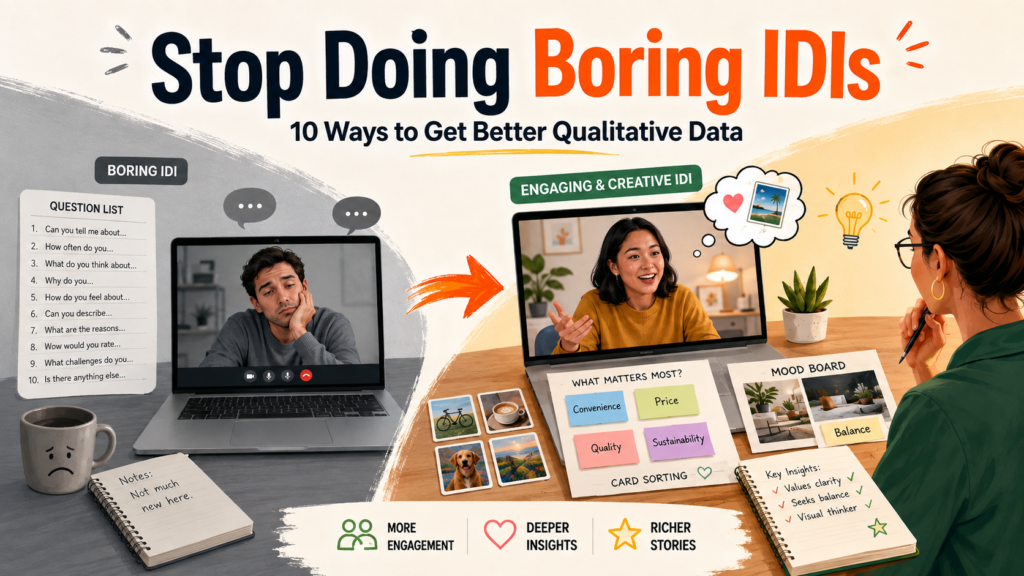

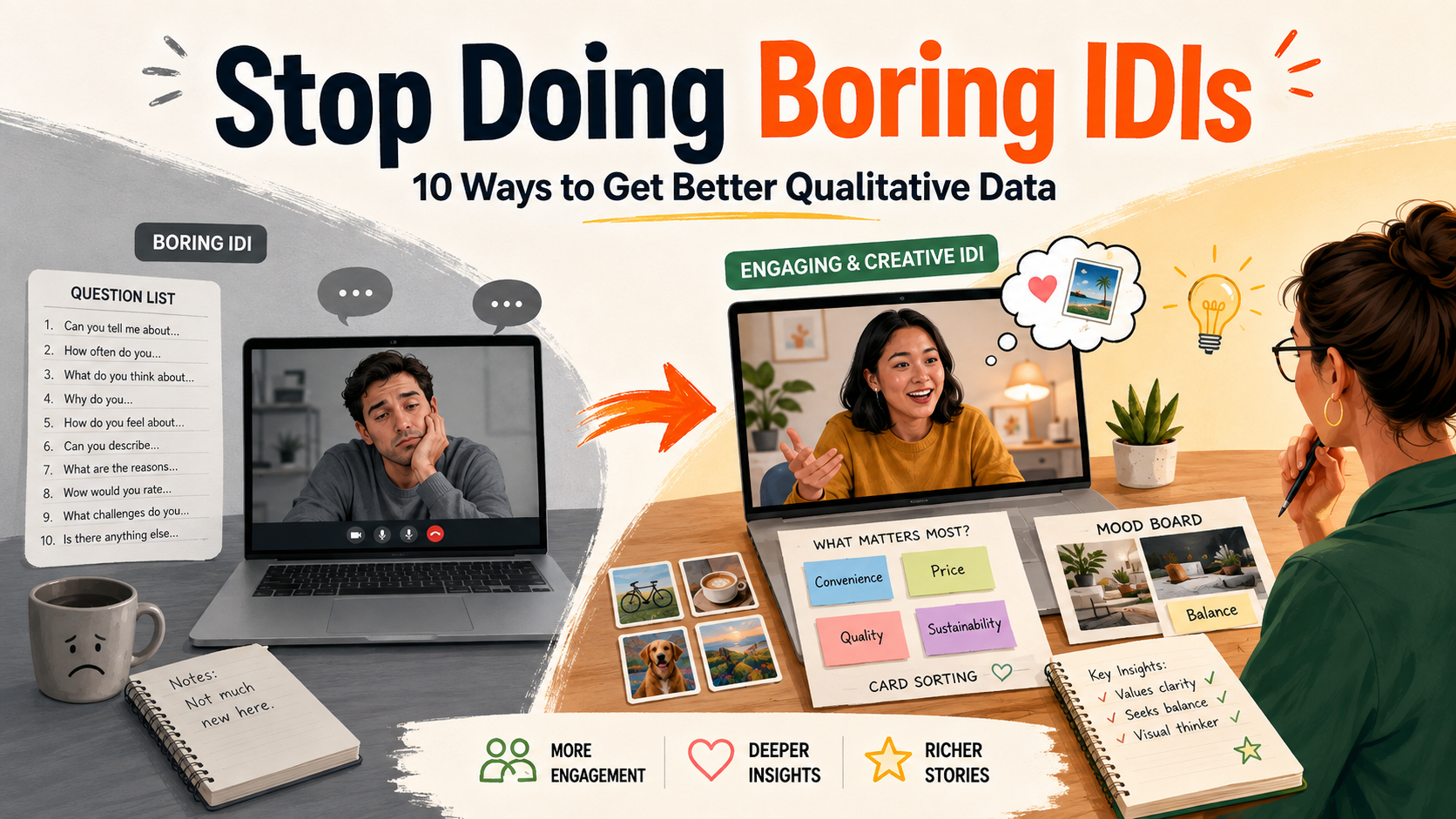
Boring IDIs create a practical research problem. When participants lose interest, they are less likely to stay fully engaged in the conversation and put sustained cognitive effort into their answers. A long stretch of direct Q&A can drag for both the participant and the interviewer, and that can limit how much useful information we uncover.
That makes “boring” more than a style issue. It becomes a qualitative data quality issue. If participants give us only the easiest, most rational, or most socially acceptable answer, we may leave the interview with an incomplete or inaccurate picture. Creative techniques that move away from basic Q&A can help keep people engaged by giving them more ways to share context, emotions, motivations, and experiences that may not emerge through direct questioning alone.
In Research Rockstar’s recent Stop Doing Boring IDIs Live Event, qualitative research pros Marni Martens and Jennifer Floyd shared practical techniques they’ve used in real qualitative research. Just as important, they explained when to use them and how to avoid turning an IDI into a collection of activities that don’t serve the research.
Here are 10 takeaways for researchers who want to conduct better IDIs.
1. Direct Questions Aren’t Enough
Direct questions matter. But sometimes participants simply don’t have a ready answer for why they behaved a certain way, made a decision, or felt something about a brand or experience.
Marni pointed out that people may unintentionally over-rationalize their behavior or construct an explanation just because they were asked. Social desirability can also affect answers, especially around sensitive topics.
That doesn’t make direct questions useless, just that in some cases we need to offer additional ways to help participants access and express what sits below the first answer.
2. Start With the Objective
Jen and Marni emphasized this point throughout the session: start with the research objective, not the creative technique.
An activity doesn’t belong in an IDI because it looks interesting or because we’ve been waiting for an excuse to try it. We should know what it is intended to help us understand.
Jen offered several useful matches between objectives and approaches:
- Use association techniques for immediate, top-of-mind reactions.
- Use projective techniques for sensitive subjects, hidden perspectives, or difficult-to-express feelings.
- Use sorting and ranking for priorities and trade-offs.
- Use construction activities for ideal experiences, possibilities, and more abstract topics.
Of course, there are exceptions. What matters is being able to connect the exercise back to the business question and research objective.
3. Give Participants More Ways to Respond
People differ in how they express themselves.
Some participants can answer an abstract question about emotions or brand meaning quite easily. Others may respond more fully when they can choose an image, tell a story, sort options, or react through a hypothetical scenario.
That’s one of the strongest reasons to build different techniques into our qualitative toolkit. We aren’t replacing direct questioning. We’re creating additional paths to the information we need.
For data quality, this is important. If one type of question limits what a participant can tell us, another format may help us get a more complete, candid response.
4. Use Associations to Get Past the First Answer
Association techniques capture immediate connections to a brand, experience, idea, or other research topic.
Jen shared several variations. We can ask for the first word that comes to mind, request several descriptive words, or use a 10-5-1 exercise: start with 10 words, narrow them to five, and then select one.
The important part comes next. If a participant says a brand is “simple,” we still don’t know exactly what that means. Is simple positive? Negative? Easy to use? Visually minimal?
As Jen emphasized, the word itself isn’t enough; we need to understand what the participant means by it.
5. Use Images to Make Feelings Easier to Express
Images can give participants a visual vocabulary for feelings that are difficult to put into words.
Jen described research about switching computer operating systems. Participants selected images representing how switching felt, including an obstacle course and a dark forest.
The image wasn’t treated as a finding by itself. Jen asked participants to explain why they chose it.
An obstacle course led to discussion about barriers, transferring information, learning a new system, and taking steps forward and backward. A dark forest brought out concerns about uncertainty and not knowing what might be lost during the transition.
Marni demonstrated the same idea during the webinar with an image exercise about the transition from summer to fall. Different participants interpreted the images differently, which reinforced an important point: we don’t assign the meaning. The participant does.
6. Use Projection to Create Distance
Projective techniques allow participants to respond through another person, character, story, or scenario.
That distance can make it easier to talk about topics that feel sensitive, socially undesirable, uncertain, or difficult to articulate.
Jen gave examples such as asking why someone might hesitate to tell family members about a purchase or imagining why a shopper might put an item into a cart and then return it to the shelf.
She also shared an insurance project example in which participants used a cartoon-style story to describe their experience with insurance over time, including the characters involved, important transitions, thoughts, tensions, and what might happen next.
The projection opens the conversation. Then we can bring it back to the participant by asking how similar or different that scenario is from their own experience.
7. Ask Participants to Build Something
Construction techniques ask participants to create a story, collage, drawing, mood board, narrative, or ideal experience.
Marni stressed that the thing participants create is not necessarily the finding. Its real value is that it gives us something concrete to discuss and probe.
She shared a brand-obituary exercise used in research for a heritage household brand. Participants wrote a eulogy as pre-work, then discussed what they would miss, how the brand’s absence would affect them, and which parts of the brand’s heritage still mattered.
Those conversations helped surface both emotional and functional qualities associated with the brand.
For a researcher, that’s the payoff: the activity gives us more material for understanding what participants mean and why it matters.
8. Use Sorting to Force Trade-Offs
Participants can tell us that many things are important. Sorting and ranking activities help us understand what is more important than what.
Marni shared a website-redesign study in which participants sorted 15 website elements into categories such as “most important,” “nice to have,” and “not needed.”
She then added another layer. Participants selected up to three items they wanted above the fold and two additional important items that could appear farther down the page.
The activity created differentiation, but Marni still used the discussion to understand the reasoning behind those choices.
9. Protect Time for the Debrief
Creative exercises can take longer than expected. Participants need time to understand the instructions, complete the task, make choices, and explain what they did.
For more involved activities, Marni sometimes uses pre-work. She described doing this with brand obituaries and collages so the live IDI could focus on discussion rather than creation.
She also noted a newer challenge: participants may use AI tools to complete pre-work. In one recent study, she suspected AI had been used in some written responses. The live interview gave her an opportunity to move beyond those responses and hear participants describe their own feelings directly.
Whether an activity happens before or during the interview, we need enough time to debrief it.
That’s where much of the useful qualitative information emerges.
10. Plan, Practice, and Be Ready to Pivot
Creative techniques won’t work equally well with every participant.
Jen recommended warming people up before introducing an unfamiliar or emotionally revealing exercise, keeping instructions clear, checking that the participant understands the task, and reading the room.
Some people immediately engage with metaphors and projective techniques. Others stay very literal. If repeated probing isn’t getting us anywhere, forcing the exercise usually isn’t the answer.
Have a Plan B.
Marni often prepares direct probes she can use if something doesn’t emerge through the creative activity. Jen similarly suggested shifting back to a more direct question when that approach works better for the participant.
That flexibility supports better data quality too. Our job isn’t to make every participant complete an activity exactly as designed. Our job is to get useful, complete information that addresses the research objective.
The Activity Is the Beginning
One message came through again and again in Jen and Marni’s webinar: always debrief with the participant before concluding the creative exercise.
A selected image, sorted card, metaphor, cartoon, or collage is rarely meaningful on its own. We need to ask what the participant saw, why they made that choice, what was difficult, what they considered and rejected, or how the activity connects to their actual experience.
A big thank-you to Jen and Marni for sharing not just a great set of techniques, but the judgment behind when and how to use them. Their real-world examples showed that stopping boring IDIs isn’t about adding gimmicks. It’s about keeping participants engaged, helping them express more of what they think and feel, and giving researchers richer, more complete qualitative data to work with.