
Our August and September Live Events are designed to help the Research Rockstar student community strengthen one of qualitative research’s most important capabilities: conducting effective in-depth interviews (IDIs).
Researchers use IDIs for many purposes, from discovering customer attitudes and behaviors, testing responses to new products and services, to exploring the “why” behind changes in demand, to name just a few. IDIs can generate rich insights relatively quickly and cost-effectively, and the method works across many consumer and B2B research populations.
But the heat is on. AI interviewers are now a reality, and they will be used for some market research projects. They can provide scale, consistency, and 24/7 availability that human interviewers cannot match.
Does that mean skilled human interviewers are becoming obsolete? Will demand for human interviewers stop? We don’t think so. But it does mean we need to be clear about the value human interviewers promise, and we need to deliver on those promises.
The bottom line is that qualitative research practitioners need to ask: are we consistently demonstrating the uniquely human capabilities we promise? If not, mediocre interviewers and moderators will struggle to compete with AI. Skilled ones can.
Comparing Human to AI Research Interviewers
A skilled human interviewer can build the rapport needed to elicit more candid sharing, recognize (and delicately probe) when an answer does not quite add up, adjust to an unexpected turn in the conversation, and have the nuanced understanding to judge whether that turn is worth pursuing. A skilled human interviewer can also use projective techniques and probe to better understand what participants’ responses reveal.
We have yet to see an AI interviewing demonstration that rivals a strong human interviewer. But we have seen AI demonstrations that can rival interviewers who follow a discussion guide robotically.
This is why building strong interviewing skills matters.
Essential Skills for Human Research Interviewers
Research on interviewing points to several skills that distinguish effective qualitative interviewers/moderators.1 Two are featured in our Fall expert-led Live Events.
1. Probing beyond the first answer
In qualitative research, probing refers to techniques interviewers can use to get beyond vague, incomplete, or surface-level responses. Good probing requires more than repeatedly asking “Why?” Although carefully used “why” questions can be legitimate, skilled interviewers have a much broader set of options. They listen for places where more depth seems likely, then choose a non-leading probe that fits the moment without introducing unnecessary bias.
- August 11: Advanced IDI Interviewing Skills: Probing Techniques for Challenging Interviews. Special guest instructor Stacy Graiko brought her extensive qualitative research experience, including having conducted hundreds of IDIs and focus groups with populations that can be especially challenging to interview. In this Live Event, Stacy demonstrated how strong interviewers recognize when to probe and how to select techniques that encourage greater depth without leading the participant. Good probing instances are the moments that can produce the “aha” insights human qualitative research does especially well. Did you miss it? See highlights here.
2. Creating and maintaining participant engagement
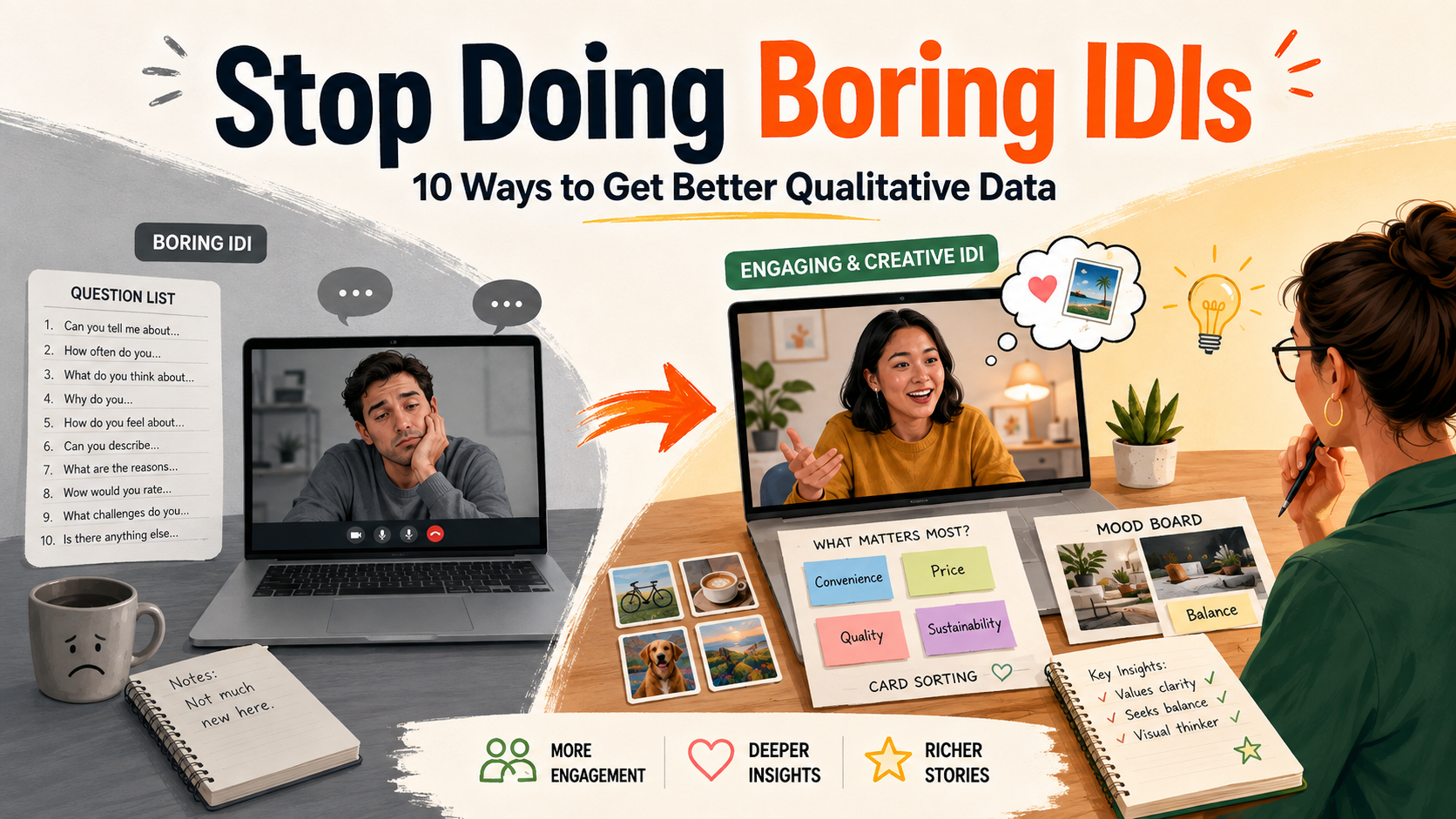
Engagement is not just about making an interview pleasant. It serves a methodological purpose. When participants feel comfortable, interested, and respected in the conversation, they are more likely to keep sharing. And when we move beyond basic question-and-answer formats, we can sometimes uncover reactions and associations that direct questions alone may miss.
Creative elicitation techniques can include digital collage making, heat mapping, image matching, personification, story stems, and word association (among many others).
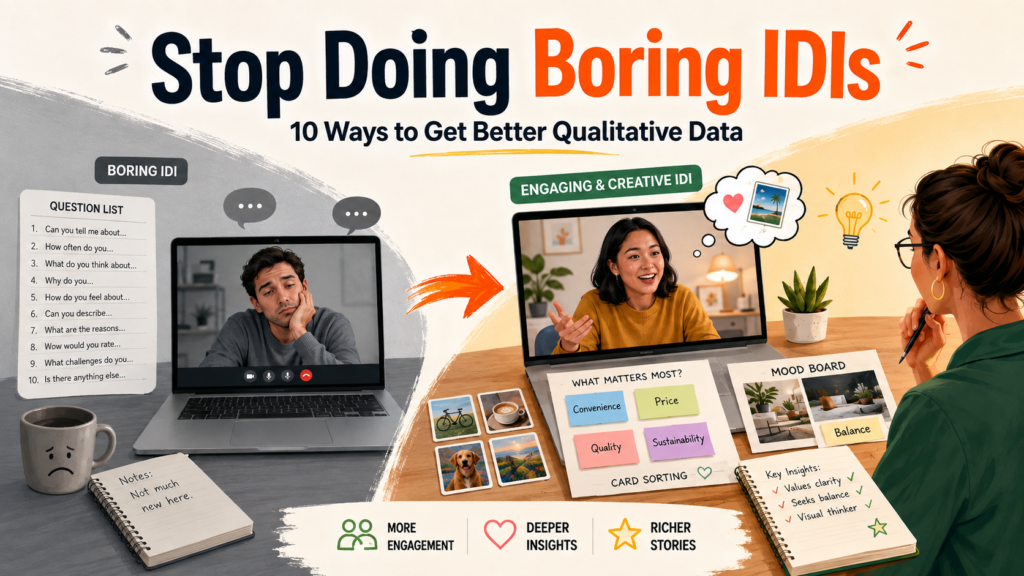
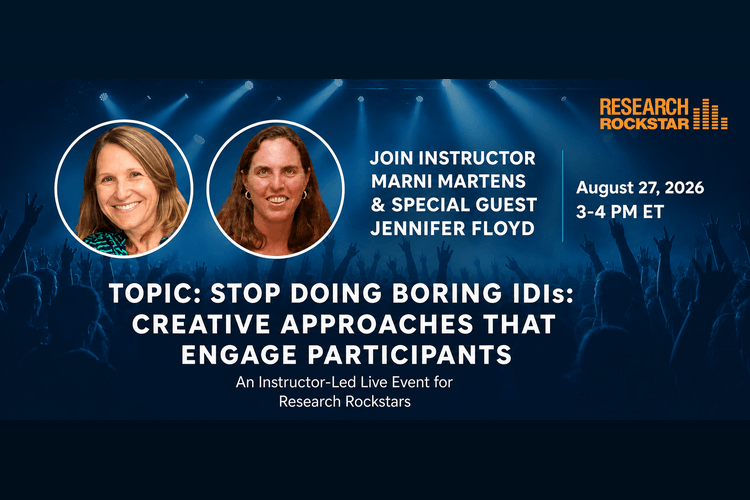
- August 27 at 3 PM ET: Stop Doing Boring IDIs: Creative Approaches that Engage Participants. Join qualitative research pros Marni Martens and Jennifer Floyd for practical examples of creative elicitation techniques and guidance on when to use them. We will look at approaches such as word association, story stems, image matching/sorting, personification, heat mapping, and digital collage. The goal is not creativity for creativity’s sake. It is to move beyond basic Q&A when another approach can generate richer, more revealing participant responses. Save your spot here.
From Knowing IDI Techniques to Applying Them
Knowing interviewing techniques is one thing. Applying them in real time is another.
We can learn probing techniques, rapport-building strategies, and creative elicitation methods, but during an actual interview, we have to listen actively, decide what matters, formulate the next question, avoid leading the participant, monitor time, and be professional—all while another person is sitting on the other side of the webcam watching us.
Interestingly, the same AI technology creating new competition for human interviewers can also serve as a training tool, providing new opportunities to practice and strengthen interviewing skills.
Traditionally, practicing IDIs has been difficult. Recruiting people for practice interviews would be ideal, but it is seldom practical. Role-playing with colleagues can help, but colleagues already know how research interviews work and have a hard time behaving like actual participants. AI avatars give us another option.
Using AI Simulations to Practice Human Interviewing Skills
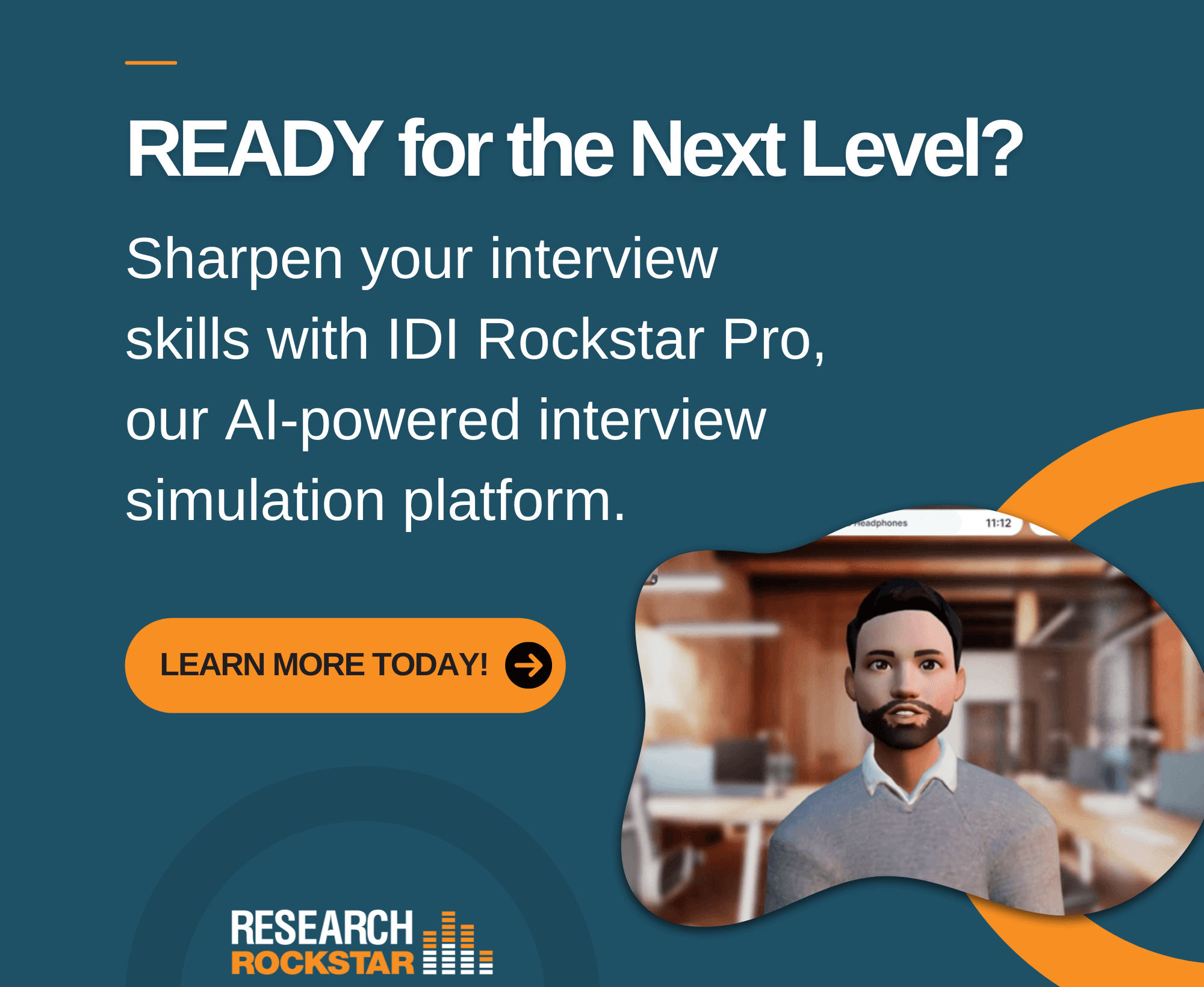
September 24: Conducting Awesome Webcam Interviews: IDI Practice with AI Avatars
Instructor Kathryn Korostoff will lead this hands-on Live Event focused on applying IDI best practices in real time. Attendees will practice by interviewing AI avatars designed to simulate research participants. The avatars respond dynamically to the interviewer’s questions and also exhibit a range of participant response behaviors, from curt or impatient to highly chatty (just like we encounter in the real world).
AI provides a practical way to simulate the experience of interviewing human participants, and after each interview, our AI Coach provides feedback on what the interviewer did well and where they can improve.
The Opportunity for Human Researchers
AI interviewers will handle some interviews that previously would have been conducted by people. That change is worth taking seriously. If we want to prevent that shift from becoming a landslide, the onus is on human researchers to demonstrate where skilled human interviewing is genuinely better. Simply being human is not enough.
That means when a research situation calls for judgment, adaptability, rapport, creative elicitation, and nuanced probing, we need to be genuinely good at those things. If an AI-favorable client gives a project to a human researcher but comes away feeling that the interviewer did a poor job establishing trust, probing effectively, or adapting to the conversation, that client will be more likely to choose AI-based data collection next time.
Related content:
- A Candid Conversation about IDI Research, from Research Rockstar Training
- Can We Trust AI to Moderate UX Interviews, from MeasuringU
- Effective Interviewer Traits, from Research Rockstar Training
Already a student in the Qualitative Research Mastery Lab? Remember: you can practice your interviewing skills with our AI Avatars 24/7. Click here to go directly to the avatar page in your student dashboard.