Google Analytics is a powerful tool that tracks and analyzes website traffic for informed marketing decisions.
Service URL: policies.google.com (opens in a new window)
_gid
ID used to identify users for 24 hours after last activity
24 hours
_gat
Used to monitor number of Google Analytics server requests when using Google Tag Manager
1 minute
_ga
ID used to identify users
2 years
_gali
Used by Google Analytics to determine which links on a page are being clicked
30 seconds
_ga_
ID used to identify users
2 years
__utmv
Contains custom information set by the web developer via the _setCustomVar method in Google Analytics. This cookie is updated every time new data is sent to the Google Analytics server.
2 years after last activity
__utmx
Used to determine whether a user is included in an A / B or Multivariate test.
18 months
__utmc
Used only with old Urchin versions of Google Analytics and not with GA.js. Was used to distinguish between new sessions and visits at the end of a session.
End of session (browser)
__utmz
Contains information about the traffic source or campaign that directed user to the website. The cookie is set when the GA.js javascript is loaded and updated when data is sent to the Google Anaytics server
6 months after last activity
__utma
ID used to identify users and sessions
2 years after last activity
__utmt
Used to monitor number of Google Analytics server requests
10 minutes
__utmb
Used to distinguish new sessions and visits. This cookie is set when the GA.js javascript library is loaded and there is no existing __utmb cookie. The cookie is updated every time data is sent to the Google Analytics server.
30 minutes after last activity
_gac_
Contains information related to marketing campaigns of the user. These are shared with Google AdWords / Google Ads when the Google Ads and Google Analytics accounts are linked together.
90 days


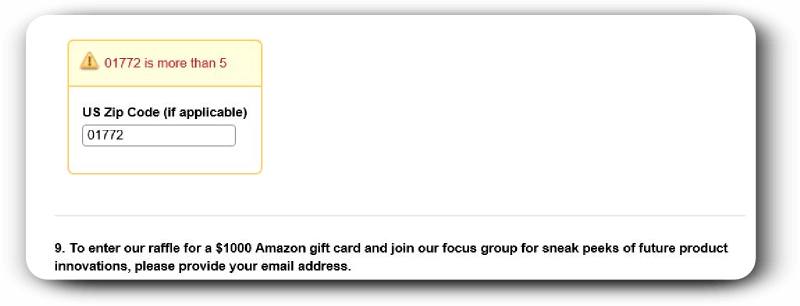 Check out this image (click to enlarge). This is from a questionnaire sent to Kathryn Korostoff from our web hosting company. So after nicely filling out the survey, what did she encounter? A bad field (zip code) and a bait-and-switch. The survey invitation had stated, “Once you’ve completed the survey, you’ll be entered to win a $1,000 Amazon Gift Card.” What do you notice in the text from the screenshot? That’s not cool. It’s a sure way to annoy the people nice enough to take time to answer your survey.





3 comments
Sigh. This is why hiring a professional market researcher is so important. Leaving research participants with a good feeling in the end matters more than building an email list.
It’s also why any DIY market researcher had better be sure they’re testing their surveys before going live with them. At least that would address the bad zip code field (not so much the bait and switch — that’s just flat out not cool).
Unfortunately, I’ve seen MUCH worse than this one – poorly constructed scales, leading questions, questions where one has no idea what’s even being asked, order bias, missing common potential answer options without including “other”/ “NA”. I took a survey just last week like this – it was so bad that I was embarrassed for the firm in question (and it was a well known brand).
I’ve personally seen and heard of instances where legitimate design feedback from research professionals (in the rare instances where they were consulted), was explicitly ignored by junior staff with no research experience and/or limited business experience (the profile of who these sorts of efforts gets delegated to). They typically seem to naively assume they don’t need a research department/vendor, because how hard can it be to write a questionnaire, right? They wrote a questionnaire once for a class in college… I shudder to think of the number of bad business decisions being made as I write this based on the faulty data from studies performed by the untrained.