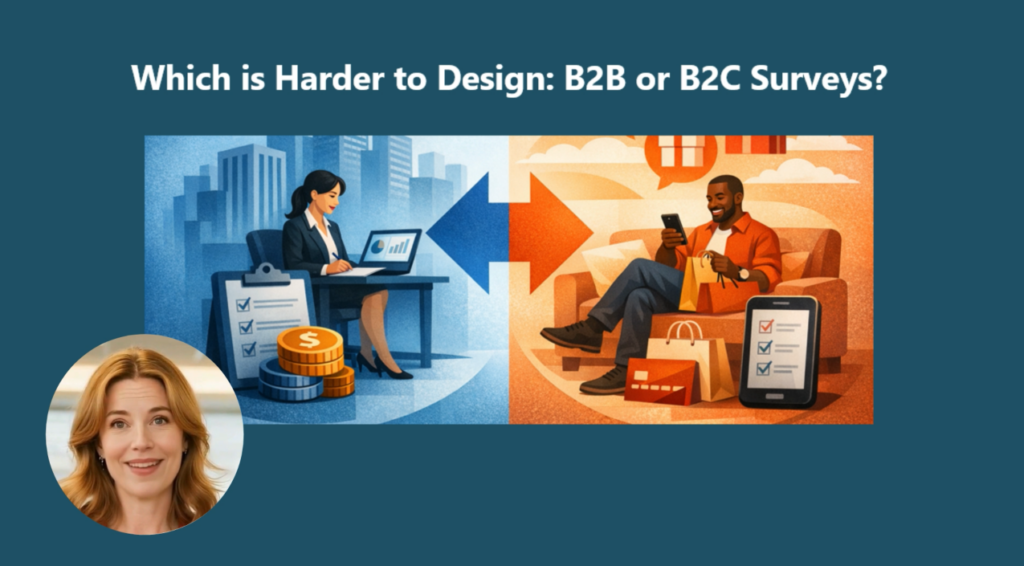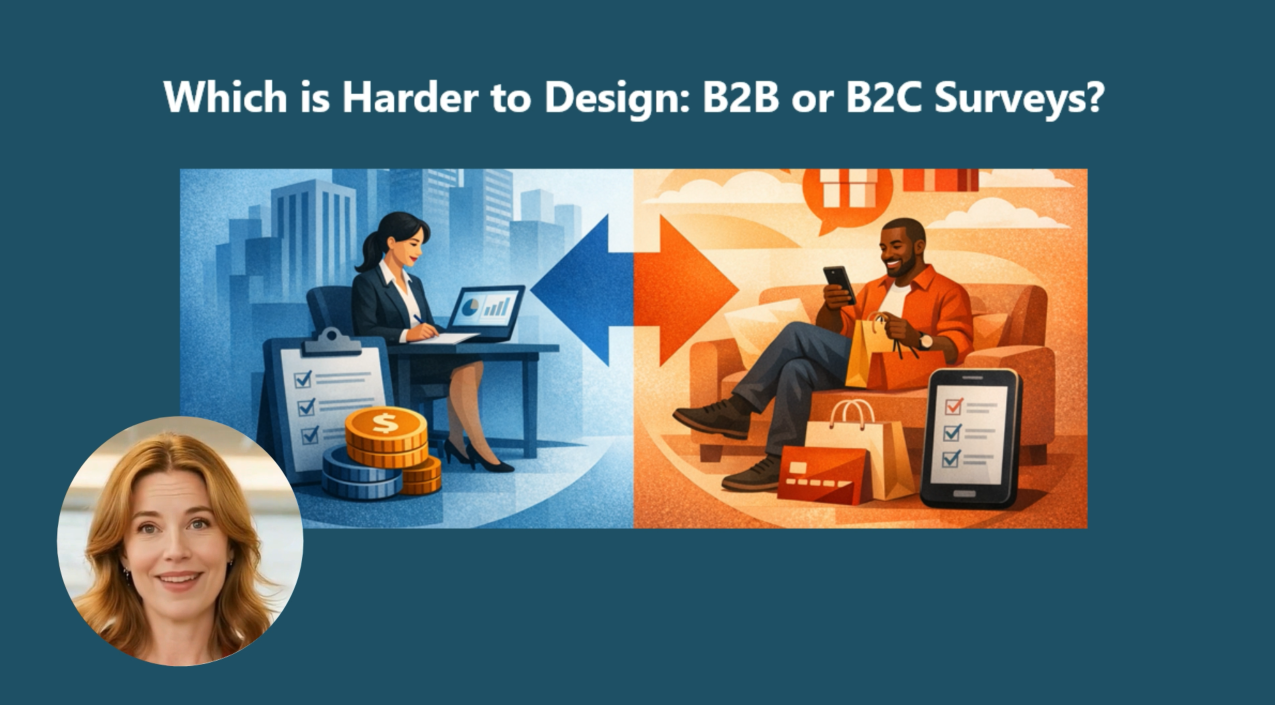
Which is harder to design: business-to-business surveys or business-to-consumer surveys?
A lot of people instinctively say they’re equally difficult. At a high level, that’s true. But once we get into real-world projects, business surveys bring a distinct set of constraints that can quietly damage data quality and the respondent experience if we don’t plan for them.
Below are seven common B2B questionnaire design challenges, along with solutions that keep surveys manageable for busy professionals and useful for decision-making.
1) Higher Sample Costs Mean Less Room for Error
In business research, qualified respondents are often expensive to reach. Unless we have access to a client’s customer list (which we don’t always have), recruiting costs add up quickly. It’s not unusual for online panel completions with business professionals to run $30 per complete, and sometimes much more, depending on seniority and industry.
That changes the math. In consumer work, we can often identify poor-quality responses and replace them because the pool of potential respondents is large. In B2B, the universe is smaller. If we lose qualified people to survey fatigue or confusing questions, we may not be able to replace them easily.
Example: If we’re studying commercial painting businesses and how they choose interior paint brands, we don’t just need painters. We need the people who control paint brand selection decisions. Those decision-makers are harder to find and costlier to recruit than consumers buying paint for home projects. They’re also busy professionals, often on job sites or driving between job sites, which makes them harder to reach.
Solutions
- Keep questions short, concrete, and unambiguous.
- Cut anything not tied to a real decision.
- Avoid complex grids and repetitive items that inflate time without improving clarity.
2) Anonymity Worries Reduce Participation
Many business professionals decline survey invitations because they’re concerned their responses won’t be anonymous. Sometimes the fear goes further: respondents worry their answers could be traced back to their employer, and that can feel like a job risk.
If we don’t address confidentiality early, we can lose the very people we need most. Or we may get guarded responses that look complete but lack candor.
Solutions
- State confidentiality and anonymity up front in plain language.
- Clarify that personally identifiable information won’t be linked to survey answers.
- Consider offering multiple modes (online, phone, paper) so respondents can choose what feels most private and comfortable.
3) Longer Surveys Increase Dropouts and Satisficing
Because B2B completes are costly, some clients try to “get more value” by adding extra questions. Unfortunately, longer surveys often do the opposite of what we want: they increase dropouts, encourage rushed responses, and can raise field costs.
A helpful reminder for stakeholders is that cost per complete is only part of the story. Cost per usable complete is the real metric.
Solutions
- Prioritize need-to-know questions and remove nice-to-know items.
- Use a time budget and protect it.
- When the scope expands, ask a simple gut-check: Would we personally complete this survey?
4) Mixed Perspectives Create Unclear Answers
In B2B surveys, respondents may answer from a personal point of view or from the company’s perspective unless we specify which we want. Both perspectives can be useful, but mixing them unintentionally makes results hard to interpret.
Example: Asking painting contractors, “To what extent is fast drying time a consideration when buying interior paint?” can produce two different true answers: what the respondent personally values versus what management prioritizes.
Solutions
- Signal the requested perspective directly in the question stem.
- Use “you, personally” when we want individual views.
- Use “your company” when we want organizational policy or behavior.
5) Buyers and Users Provide Different Information
In business research, the person who purchases a product and the person who uses it are often different people. They have different goals, different incentives, and different levels of hands-on knowledge. If we don’t define which role we need, we risk asking the wrong questions or recruiting the wrong respondents.
This distinction exists in consumer research, too. A parent may buy a gaming console and answer purchase questions well, while the child is better positioned to speak to features and day-to-day usage.
Solutions
- Define the required role before writing questions or building a sample.
- Screen for purchasing authority when the buyer’s perspective matters.
- Screen for usage frequency and workflow familiarity when the user perspective matters.
6) Unclear Unit of Analysis Skews Results
Many business topics apply to the full company or only to a division, department, region, or location. If that focus isn’t explicit, respondents will answer from wherever they sit, and results can become a blend of company-wide and local realities.
Solutions
- Specify the unit of analysis at the start of the section and reinforce it as needed.
- Use clear prompts such as:
- “For these questions, please consider the entire company, including all locations.”
- “For these questions, please base your responses on your specific department or division.”
- Offer “Not applicable” and “Don’t know” options to prevent guessing.
7) Longer Screeners Reduce Space for Core Questions
Business surveys typically need longer screeners than consumer surveys because we screen for both individual and company attributes. Individual factors may include job role, tenure, and decision-making authority. Company factors may include industry, size, number of locations, or revenue.
It’s also common to need both job title and job role. Titles alone can be misleading, especially across company sizes and countries.
Example: A CEO at a small company may purchase office supplies personally, while a CEO at a large firm rarely does. Same title, very different responsibilities. In global studies, titles vary even more in meaning.
The practical impact is simple: screeners take time, which reduces the time available for core questions. In a 10-minute business survey with room for roughly 25 questions overall, we may reasonably need eight screening questions. That leaves about 17 for the main topic.
Solutions
Keep screeners tight, but don’t cut qualifiers that protect data quality. Use responsibility-based items, not just job titles. Plan the questionnaire around a realistic time budget so the core section stays focused.
The Bottom Line
B2B survey design isn’t harder across the board, but it does come with constraints that matter. The sample is costly, anonymity concerns are real, organizational context changes how respondents interpret questions, and time disappears quickly once screening is complete.
When we plan for these seven challenges, we protect the respondent experience, improve data quality, and produce results stakeholders can trust. That’s the kind of work worth turning up loud, in the best way. 🎸
Check out the related, just-released episode on Conversations for Research Rockstars. Also available on Apple Podcasts and Spotify.